Nagasaki: Peace Park, Glover Garden, Dejima, champon in Chinatown and the night view from Inasa
The city that was Japan's only window to the world for 200 years, and was then wiped out by the second bomb: a memorial and a museum in the morning, the Scottish merchants' houses on the hill, the artificial Dutch island, and a spectacles bridge. A city on slopes, with a tram.
A day in Nagasaki, a city on slopes that you get around by tram. You start in the morning at Peace Park and the Atomic Bomb Museum, ride to the Spectacles Bridge, and eat champon down by the harbor. In the afternoon you walk up to Oura Cathedral and Glover Garden, come down to Dejima, and in the evening ride the ropeway up Mount Inasa for the night view. The tram is ¥150 a ride, and this day has five rides, ¥750, so the day pass, ¥600, pays off. It is sold at the tourist information center and at the front desks of the hotels along the line, not on the tram.
The day on a map
8 stops, in order
- Stops
- 8
- Walking minutes
- 19
- Peace Park, then Train 32 min
- Meganebashi Bridge, then Train 17 min
- Lunch break in Oura, then Walk 5 min
- Oura Cathedral, then Walk 3 min
- Glover Garden, then Train 18 min
- Dejima, then Walk 11 min
- Early dinner in Shianbashi or at the station, then Bus 33 min
- Mount Inasa Ropeway
The same stops with the same numbers, and the way from stop to stop. On a phone it opens in the app, and that is what you navigate with in Japan. Pin names on the map are in Hebrew.
Getting there: You start at the Atomic Bomb Museum. From Nagasaki Station, take the tram toward Akasako, 10 minutes, ¥150, to the Genbaku Shiryokan stop, or one stop farther, to Heiwa-koen, near the Peace Statue. From Fukuoka: the Kamome Shinkansen (since 2022) with a change, 80 minutes, ¥6,000.
Stop 1Memorial and museumMust
Peace Park, the hypocenter and the Atomic Bomb Museum
You start on 9 August 1945, 11:02. The giant Peace Statue, one hand to the sky and one to the side, a black pillar at the hypocenter, and the remains of the cathedral. The museum (¥200) is small and hard, like Hiroshima's, with a clock that stopped at 11:02. From 24 November 2026 until March 2027 Section C is closed for renovation, and most of Section B, with the objects from the blast, stays open. Two hours, and some fresh air afterwards.
Ride to the Spectacles Bridge
Stop 2BridgeRecommended
Meganebashi Bridge: the Spectacles Bridge and the heart stone
A stone bridge from 1634, the first in Japan, with two arches that reflect in the water like a pair of spectacles. Look for the heart stone in the river wall: it brings luck in love, and there is a line of tourists for it. Free. The parallel street has castella shops, the Portuguese cake that became Nagasaki's souvenir (Fukusaya, since 1624).
Ride to lunch by the harbor
Stop 3LunchMust
Lunch break in Oura
Eat champon, noodles in a milky broth with seafood and vegetables, invented by a Chinese immigrant in 1899 for hungry students. After lunch you walk up from here to the cathedral. The options:
Up to the cathedral
Stop 4ChurchRecommended
Oura Cathedral: the oldest church in Japan and the hidden Christians
A white Gothic church from 1864. Here farmers who had been secret Christians for 250 years revealed themselves to a French priest, and since 2018 it has been a World Heritage site. ¥1,000 including the museum. On the slope up to it, buy castella and pudding.
On to Glover Garden
Stop 5Historic gardenMust
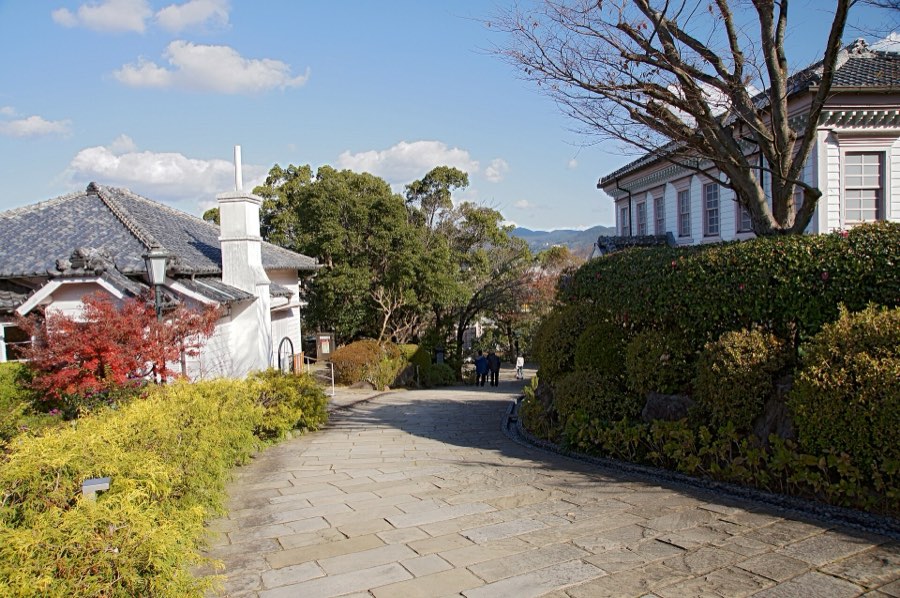
Glover Garden: the Scottish merchants' houses on the hill
The villa of Thomas Glover, the Scot who sold weapons and ships to the samurai who toppled the shogun, and who built the Kirin brewery. A hillside garden with moving walkways, 9 colonial houses and a view of the harbor and the Mitsubishi shipyard. Since 1 April 2026 entry is ¥1,300. Puccini's 'Madama Butterfly' is set in Nagasaki, and there is a statue in the garden.
Down to Dejima
Stop 6Historic siteRecommended
Dejima: the Dutch artificial island
The fan-shaped island where the Dutch were confined for 200 years, the only Westerners in closed Japan. It was reconstructed with houses, warehouses and a kitchen, and a new bridge restores the original entrance. Since 1 April 2026 entry is ¥1,100. The story here is how Japan learned medicine, astronomy and beer from a few bored merchants.
Break
A rest at the hotel, if you are staying near Dejima, in Hamanomachi or near Nagasaki Station
This day starts at 08:30 and ends at 20:00 on the mountain, and after Dejima there is an early dinner marked 'If there is time'. Go back to the hotel instead. If you are staying near Dejima, in Hamanomachi or in Shianbashi, it is a walk of up to 10 minutes. If you are staying near Nagasaki Station, ride Line 1 from the Dejima stop, 5 minutes, ¥150, and at 18:00 head straight from the station to the ropeway. You eat dinner at the station after the ropeway, at Soshurin, which is open until 22:00. If you are staying farther away, do not go back: eat an early dinner in Shianbashi as planned.
Walk to Shianbashi
Stop 7Early dinnerIf there is time
Early dinner in Shianbashi or at the station
Eat early, because the ropeway is waiting. Nagasaki's third dish, after champon and castella, is toruko rice: the plate for big kids, spaghetti Napolitan, tonkatsu and pilaf rice on one plate. The options:
Ride to the ropeway
Stop 8ViewpointMust
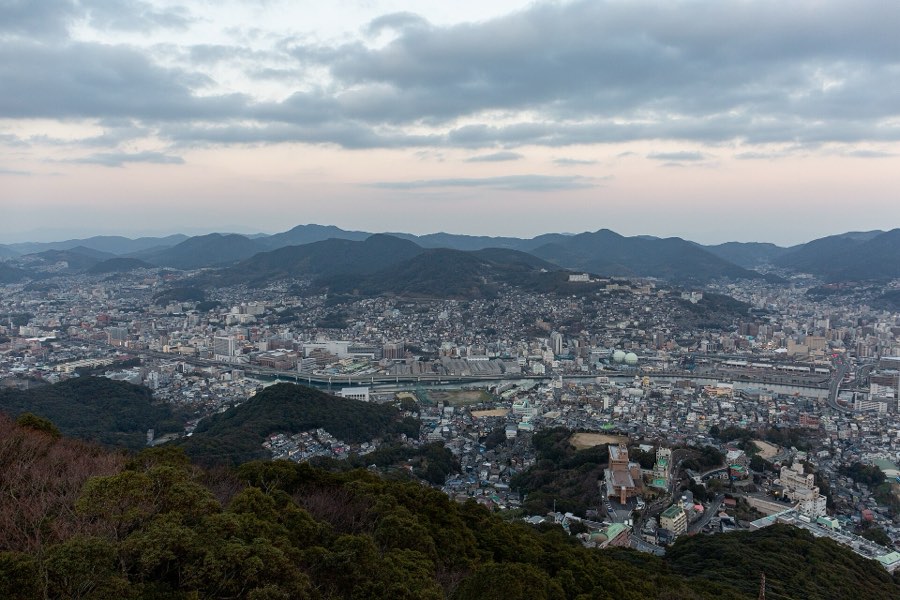
Mount Inasa Ropeway: the $10 million night view
From 333 meters the harbor is an amphitheater of lights, one of Japan's top three night views. Since 1 April 2026 the ropeway costs ¥1,900 round trip, runs every 15 to 20 minutes, and the last ride up is at 21:00. The free shuttle leaves the major hotels and JR Nagasaki Station only at 19:00 and 19:30, and you sign up for it in advance online. The line in season is 40 minutes, so arrive at sunset. Go back to the city by bus to the station, or on the shuttle, which goes down at 20:30, 21:00, 21:30 and 22:10, and eat castella at the hotel.
Want to build your own trip, day by day?
JourneySketch is a trip planner we built: a plan for each day, flights, hotels and a packing list, all in one place. No signup needed.
More in the same area
Full day · Beppu
Beppu: the seven hells, a sand bath, food steamed in volcanic vapor and onsen on every corner
Full day · Naha, Okinawa
Naha: Shuri Castle, Kokusai Street, Makishi Market, the potters' district and a beach in the city
Full day · Fukuoka
Fukuoka: Dazaifu Shrine, the National Museum, tonkotsu ramen and the yatai stalls at night
Written as a draft and verified by hand against official sources. Opening hours and prices change, so check before you go.