Chubu & Japanese Alps · Kanazawa
Kanazawa: Omicho Market, the geisha district, Kenroku-en Garden and gold leaf
The city Kyoto was before the tourists: a garden counted among Japan's three great gardens, a fish market with crab bowls, a district of wooden teahouses, a samurai district with earthen walls, and ice cream covered in gold leaf.
A day in Kanazawa, the castle town of the Maeda family. You start with breakfast at Omicho Market, and move on to the Higashi Chaya geisha district while the streets are still empty. From there to the castle, Kenroku-en Garden and the 21st Century Museum, all three right next to each other, with lunch in between. In the afternoon you walk west to the Nagamachi samurai district and south to the Ninja Temple, and finish in the evening near the station. Almost everything is on foot, and the ride from the temple to the station is by bus, ¥220. If you also take the Loop Bus on the three stretches you could walk, four rides at ¥220, you pay ¥880, and then the day pass, ¥800, pays off.
This day is part of: From the Alps to the coast: Nagoya, Takayama, Shirakawa-go, Kanazawa and Tokyo in 6 days · Ten days in Japan: Tokyo, Hakone, the Alps, Kyoto and Osaka · Two weeks in Japan: Tokyo, Nikko, Hakone, the Alps, Kyoto, Hiroshima and Osaka
The day on a map
10 stops, in order
- Stops
- 10
- Walking minutes
- 85
- Omicho Market, then Walk 15 min
- Higashi Chaya District, then Walk 16 min
- Kanazawa Castle Park, then Walk 5 min
- Kenroku-en Garden, then Walk 6 min
- Lunch break at Shiinoki Geihinkan, then Walk 3 min
- 21st Century Museum of Contemporary Art, then Walk 15 min
- Nagamachi Samurai District, then Walk 20 min
- Myoryu-ji Ninja Temple, then Bus 25 min
- Dinner at Kanazawa Station, then Walk 5 min
- The Tsuzumi Gate lit up at Kanazawa Station
The same stops with the same numbers, and the way from stop to stop. On a phone it opens in the app, and that is what you navigate with in Japan. Pin names on the map are in Hebrew.
Getting there: Start at Omicho Market. From Kanazawa Station it is about a 12-minute walk. The Loop Bus leaves from platform 7 at the East Exit and reaches Musashigatsuji-Omicho in 5 minutes, but the first one is only at 08:30, so in the morning you walk. From Tokyo: the Hokuriku Shinkansen, about two and a half hours, about ¥14,380 with a reserved seat (covered by the JR Pass). From Kyoto: the Thunderbird limited express to Tsuruga, then the shinkansen, two and a half hours, ¥7,720 with a reserved seat. In town, the Kanazawa Loop Bus passes near every stop: ¥220 per ride, ¥800 per day.
Stop 1MarketMust
Omicho Market: a breakfast of crab and uni
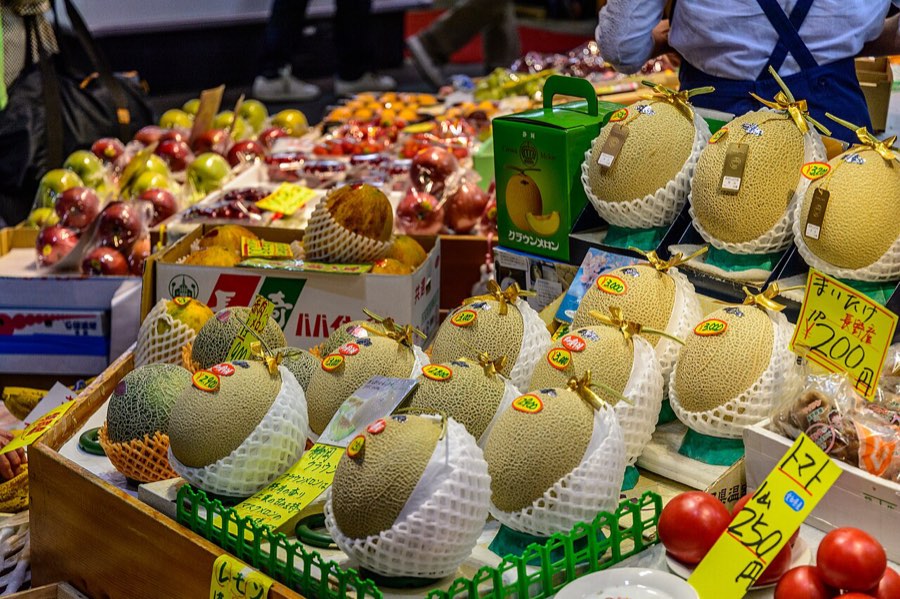
You start at a market that counts its years from 1721: about 170 shops in covered lanes, with snow crab in winter, sweet shrimp (amaebi) and uni on rice. A kaisen-don bowl costs about ¥1,200 to ¥2,900. Most shops open at 09:00, but some of the bowl restaurants open earlier: Ikiiki-tei from 07:00, and Mori Mori Sushi from 08:00. Many shops are closed on Wednesdays.
On to Higashi Chaya
Stop 2Geisha districtMust
Higashi Chaya District: the teahouse district and gold leaf
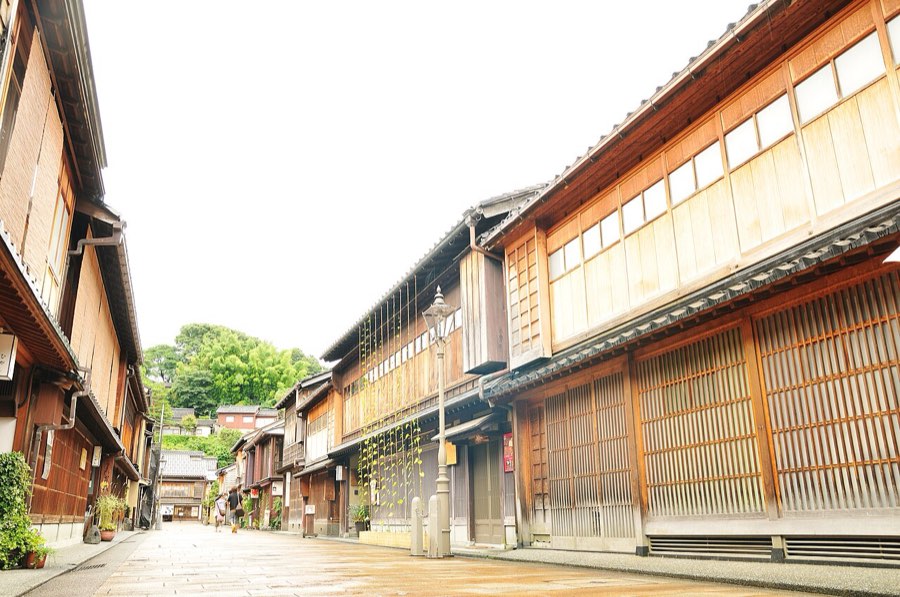
Streets of latticed wooden teahouses from 1820, where geigi, Kanazawa's geisha, still perform. Come in the morning, while the streets are still empty. The Shima teahouse (¥500) is open to visitors with its rooms and utensils from 09:30, and Kaikaro (¥750) is a working teahouse you can tour by day, from 10:00. Kanazawa produces about 99% of Japan's gold leaf: eat ice cream with a whole gold leaf (¥1,189, Hakuichi, from 09:00), or apply gold to chopsticks in a workshop (¥1,760, Sakuda). If you want to see the pool at the 21st Century Museum from below, book a queue slot for the afternoon on the museum website right now, because same-day slots open at 09:00.
On to the castle
Stop 3CastleRecommended
Kanazawa Castle Park: the gates and the white walls
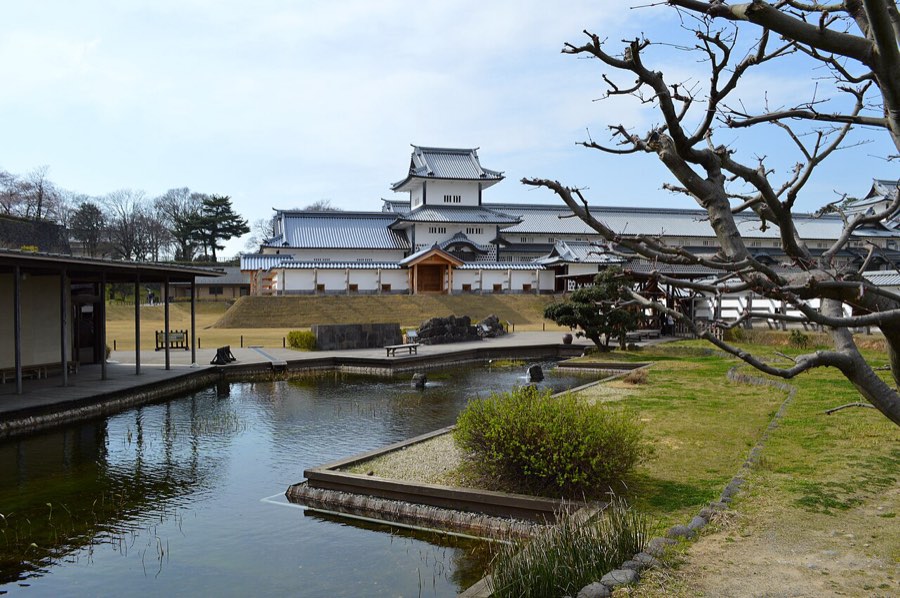
The castle burned several times and was rebuilt using traditional methods: long wooden halls with white lead-tiled roofs. The park is free, and the buildings are ¥320, or ¥500 on a combined ticket with Kenroku-en. The inner garden, Gyokusen'inmaru, was restored in 2015 with a teahouse. The 2024 Noto earthquake damaged the stone walls, and in some places access is restricted. Since 3 August 2026 the wall of the earthen bridge in front of the Ishikawa Gate is being rebuilt.
Across to Kenroku-en
Stop 4GardenMust
Kenroku-en Garden: the garden with six attributes
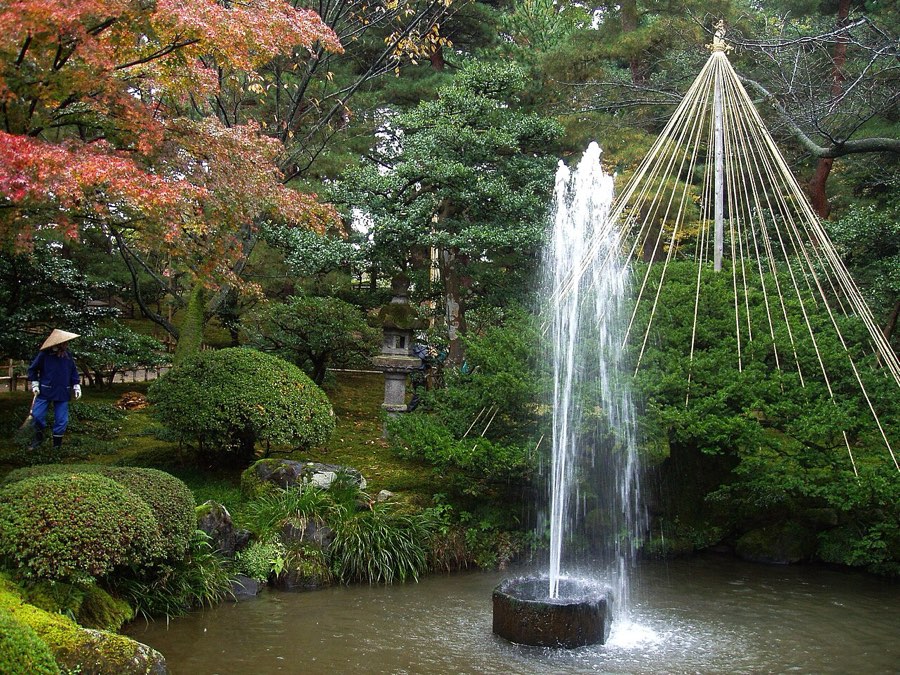
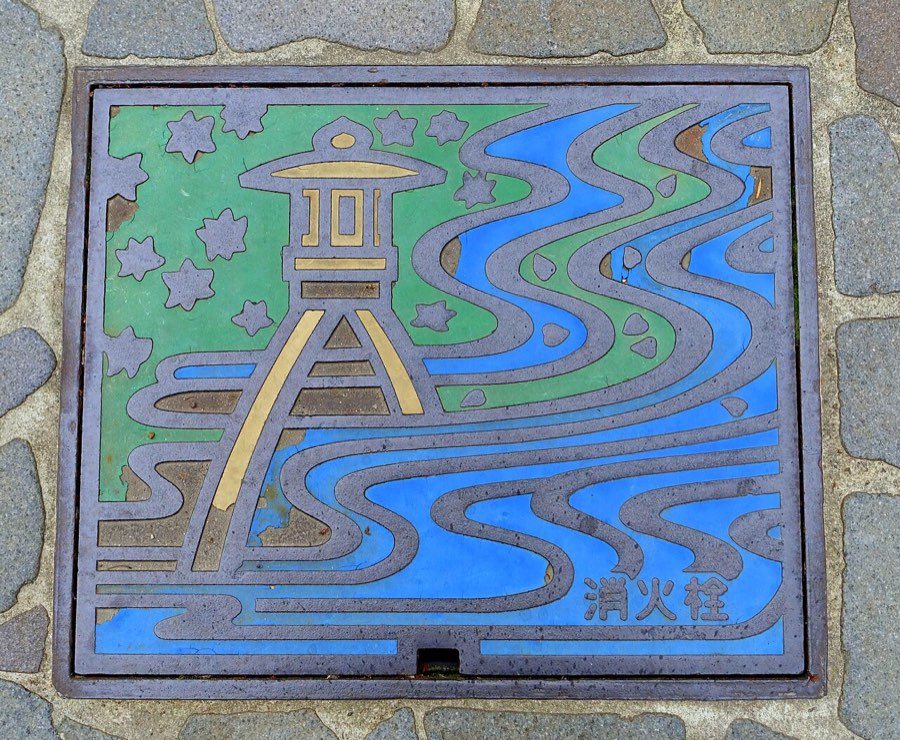
The Maeda family's garden from the 17th century, which Ishikawa Prefecture counts among the three great gardens of Japan. It has ponds, bridges, the two-legged Kotoji stone lantern, which is the garden's symbol, and a fountain said to be the first in Japan. ¥320. The garden is open from 07:00, and from 16 October to the end of February from 08:00. Every morning, before opening, you can enter free through the Hasuike and Zuishinzaka gates. In winter ropes are strung over the pines against the snow (yukitsuri), and that is the famous photo.
Down to lunch
Stop 5LunchMust
Lunch break at Shiinoki Geihinkan
Between the garden and the museum stands the former prefectural office building, whose 1924 facade was preserved. Entry is free, 09:00 to 22:00, and inside there are two Paul Bocuse restaurants. If you are still inside Kenroku-en you can eat there, and if you are already on your way to Nagamachi, eat at Korinbo. The options:
On to the museum
Stop 6MuseumMust
21st Century Museum of Contemporary Art: the swimming pool you walk into
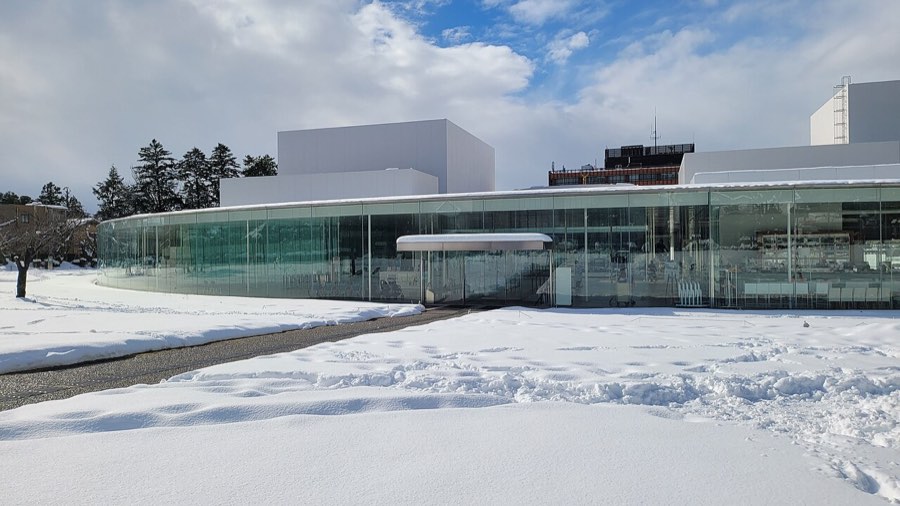
A round glass museum (SANAA, 2004) with Leandro Erlich's 'The Swimming Pool': from above you see people under the water, and from below you go inside it. The public zone is free. The collection exhibition is ¥450 until 18 October 2026, and from 31 October a new exhibition is ¥1,200 (¥1,000 online). The pool is closed 19 to 30 October. For the space under the pool you take a same-day queue slot, from 09:00, on the museum website or at the machine at the entrance, so book it in the morning. The 'Cultural Zone' pass, ¥1,000, covers 17 sites for two days, including Kenroku-en, the castle buildings and the collection exhibitions here, and is sold online or at convenience stores. The museum is closed on Mondays, and will close for renovation from May 2027 to about March 2028.
On to Nagamachi
On the way you can stop at:
- Daiwa Korinbo department store: The department store at the Korinbo crossing. In the basement there is a food hall with sweets and local Ishikawa products to buy as gifts.
Stop 7Samurai districtRecommended
Nagamachi Samurai District: the earthen walls and the Nomura family house
Lanes with yellow earthen walls, the Onosho water channel and samurai houses. The Nomura House (¥550) has a small garden awarded two stars in the Michelin Green Guide, and you drink matcha in the tearoom (¥500). From October to March the last entry to the house is at 16:00. In winter the walls are covered with straw mats against the ice.
Down to the Ninja Temple
On the way you can stop at:
- Nishi Chaya District: The teahouse district across the Saigawa River, a few minutes from the temple, which the clan also established in 1820.
Stop 8TempleRecommended
Myoryu-ji Ninja Temple: the traps inside the temple
A Maeda family temple from 1643 that looks like a two-story building from outside, and inside has 23 rooms and 29 staircases, with pits and hidden stairs. ¥1,200, cash. You enter only on a guided tour in Japanese, about 40 minutes, and only by phone reservation in advance (076-241-0888, English is possible). The last tour is at 16:00, and that is the one you book. Children below school age cannot enter.
Break
A rest at the hotel, if you are staying near the station or in Katamachi
This day starts at 08:00 and ends at 20:15, and between the Ninja Temple tour and dinner there is a gap. If you are staying near Kanazawa Station, go back to the hotel now: from the Hirokoji bus stop, 2 minutes from the temple, a Hokutetsu bus to the station, 19 minutes, ¥220. You get about 45 minutes at the hotel, and dinner is at 18:00 near the station. If you are staying in Katamachi or Korinbo, walk to the hotel in about 10 minutes, across the Saigawa River, and in the evening ride the bus to the station, ¥220. If you are staying farther away, do not go back: walk 4 minutes to the Nishi Chaya district, sit in the Muroya teahouse, which is open until 17:00 and closed on Tuesdays, and from there ride to the station.
Ride to the station for dinner
Stop 9DinnerMust
Dinner at Kanazawa Station
You end the day near the station, with no more travel, a few minutes from the gate. The city's dish is Kanazawa oden, and the fish comes from the ports of Noto. The options:
Out to the Tsuzumi Gate
Stop 10NightRecommended
The Tsuzumi Gate lit up at Kanazawa Station
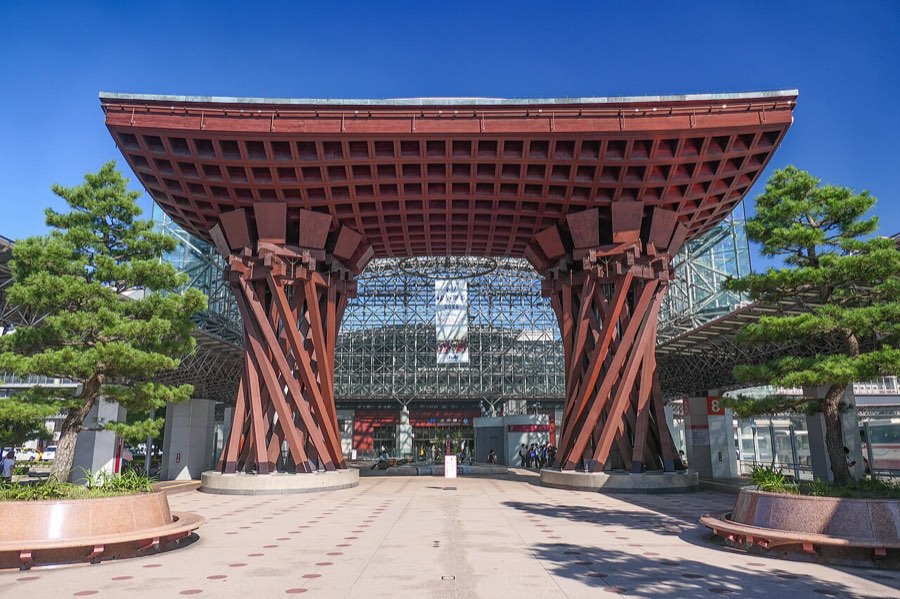
You finish at a wooden gate 13.7 meters tall, shaped like a tsuzumi drum, in front of the station, under a glass dome. On every hour, from sunset to midnight, it is lit for two minutes in the Kaga colors, so arrive before the hour. In 2011 Travel + Leisure magazine chose the station as one of the 14 most beautiful stations in the world. From there you head back to the hotel: on foot if you are staying near the station, and to Katamachi by bus, 9 minutes, ¥220.
Want to build your own trip, day by day?
JourneySketch is a trip planner we built: a plan for each day, flights, hotels and a packing list, all in one place. No signup needed.
More in the same area
Full day · Matsumoto
Matsumoto: wasabi in the field, Yayoi Kusama, the frog street and the Crow Castle
Full day · Nagano
Nagano: the snow monkeys in the onsen, Zenko-ji Temple and the town of Shibu Onsen
Full day · Tateyama, Toyama
Tateyama Kurobe: crossing the Japanese Alps from Toyama to Nagano in one day
Full day · Nozawa Onsen, Nagano
Nozawa Onsen: a ski day above an onsen village, and a free soak at Oyu to finish
Full day · GALA Yuzawa, Niigata
GALA Yuzawa: a ski day from Tokyo, with no luggage and no gear
Walks and hikes · Kiso Valley
The Nakasendo trail: Magome to Tsumago, 8 km on the samurai road
Written as a draft and verified by hand against official sources. Opening hours and prices change, so check before you go.