Chubu & Japanese Alps · Kiso Valley
The Nakasendo trail: Magome to Tsumago, 8 km on the samurai road
A 3-hour walk between two Edo-period post towns, on the road that linked Kyoto to Tokyo 400 years ago: a village on a slope with water mills, a cedar forest and bear bells, a tea house that serves free tea, and a town that banned visible power lines to stay in 1850.
A day of walking on the Nakasendo, the road that linked Kyoto to Edo, between two post towns from the Edo period. You start in Magome, climb to Magome Pass, rest at the Tateba tea house and walk down through the forest to Tsumago, where you eat soba and go into the Okuya guest house. The walk itself is 8 to 9 km, two and a half to three hours, with a short, steep climb at the start and a long, gentle descent after it. You send the suitcases ahead between the towns, and the only rides are a bus to Magome (¥800) and a bus from Tsumago to Nagiso Station (¥300).
The day on a map
7 stops, in order
- Stops
- 7
- Walking minutes
- 165
- Magome-juku, then Walk 50 min
- Magome Pass (790 meters) and the cedar forest, then Walk 15 min
- Tateba Tea House, then Walk 90 min
- Lunch break in Tsumago, then Walk 5 min
- Tsumago-juku and the Waki-honjin Okuya house, then Walk 5 min
- Kotoku-ji Tsumago, then Bus 10 min
- Dinner in Nagoya
The same stops with the same numbers, and the way from stop to stop. On a phone it opens in the app, and that is what you navigate with in Japan. Pin names on the map are in Hebrew.
Getting there: From Nagoya: the JR Chuo Line to Nakatsugawa, about an hour and a quarter, ¥1,340, and from there the Kita-Ena bus to Magome village, 25 minutes, ¥800. On weekdays the first bus leaves at 07:42 and arrives at 08:07, which fits the 06:13 train from Nagoya. On weekends and holidays the first one leaves at 08:15 and arrives at 08:40. You send the suitcase between the towns through the information centers: from 20 March to 30 November 2026, ¥1,000 per item, drop off between 08:30 and 11:30 and pick up in the other town between 13:00 and 17:00. From December to 19 March there is only delivery by reservation, ¥4,500 for up to three items. You return by bus from Tsumago to Nagiso Station, ¥300.
Stop 1Post townMust
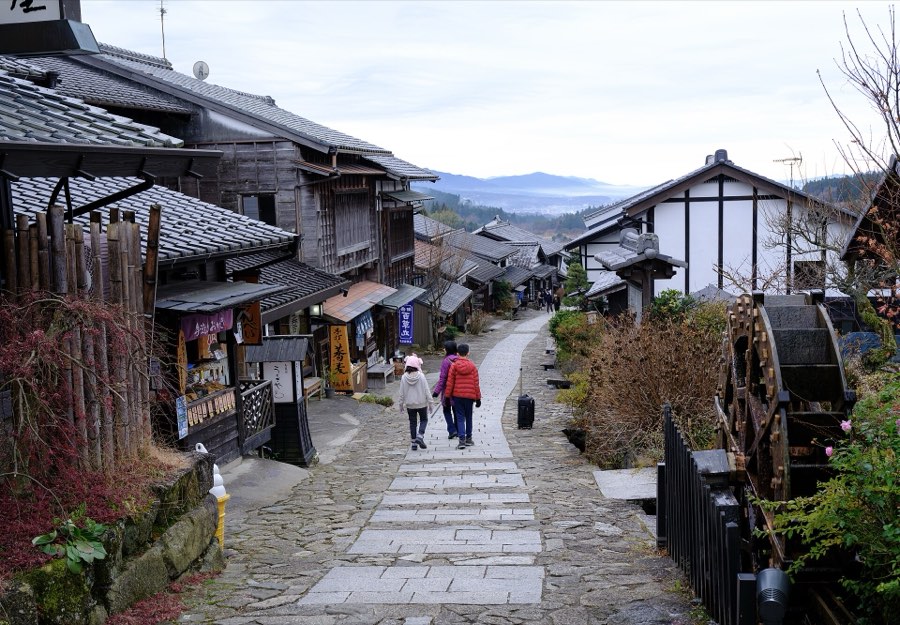
Magome-juku: the village on the slope with the water mills
You start on one steep stone street with wooden houses, water mills and shops. Arrive before 09:30, because after that the buses arrive. At the top of the village there is a viewpoint over Mount Ena, and the trail starts there. Fill up on water, because there is only one tea house on the way. If you are sending a suitcase to Tsumago, drop it off here, at the information center. That is also where you rent a bear bell, ¥100.
Up to Magome Pass
Stop 2WalkMust
Magome Pass (790 meters) and the cedar forest
The trail is signposted in English. From the pass it descends gradually through the forest, and 'beware of bears' bells hang along it: ring them as you pass. The walk is free, 8 to 9 km in all, two and a half to three hours with stops. The stone sections are old and uneven, and after rain they are slippery, so wear shoes with grip.
Down to the tea house
Stop 3BreakRecommended
Tateba Tea House: free green tea by the hearth
A tea house about two hundred years old, built as a rest stop between the towns and run today by a local association: you sit by the hearth, get hot tea and a sweet, and leave a donation in the box. Open 09:00 to 16:00 all year, not only in season. This is the point where you understand why you walked, and it is the day's rest.
Down to Tsumago
On the way you can stop at:
- Odaki and Medaki Falls: Two small waterfalls beside the trail, linked to a legend about the samurai Miyamoto Musashi.
- Otsumago: A small mountain village before Tsumago, with wooden houses protected as prefectural heritage.
Stop 4LunchRecommended
Lunch break in Tsumago
The Kiso Valley is soba country, and in Tsumago you eat in wooden houses: zaru soba with wild-vegetable tempura (¥1,400 to ¥1,800), and for dessert gohei-mochi, rice on a stick in a nut sauce (¥300). Most places close in the afternoon, around 15:00, so do not be late. The options:
On to Okuya
Stop 5Historic buildingMust
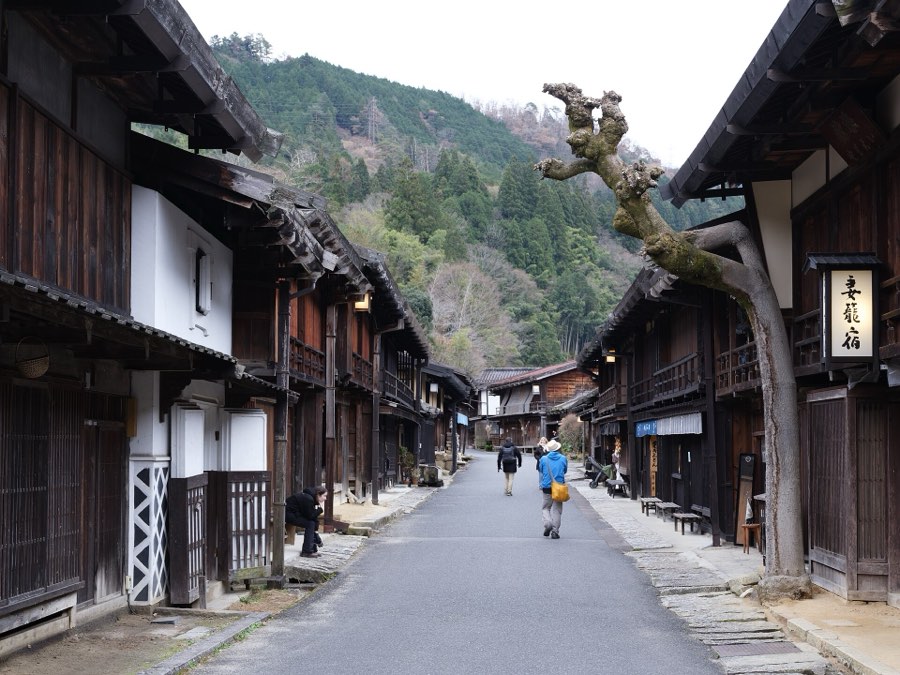
Tsumago-juku and the Waki-honjin Okuya house
Tsumago was the first town in Japan to preserve itself, in 1968: no visible power lines and no modern signs. Okuya, the officials' guest house, was rebuilt in 1877 entirely from hinoki cypress, a wood that commoners were forbidden to use at the time. In one room a single beam of light comes in through the window, and that is the famous photograph. Since April 2026 admission is ¥800, including the town's history museum. Open 09:00 to 17:00, last entry 16:45, closed on the second and fourth Thursday of the month.
On to the edge of the village
Stop 6NatureIf there is time
Kotoku-ji Tsumago: a walk at the edge of the village
At the southern end of Tsumago: Kotoku-ji temple with a 400-year-old plum tree, and a quiet stretch of trail along the river with a view over the town. Free. The last bus to Nagiso leaves at 17:41, and until then, if your legs are done, sit down for coffee in a wooden house near the bus stop.
Ride to Nagiso Station
Stop 7DinnerMust
Dinner in Nagoya, Matsumoto or Tsumago
From Nagiso Station you head back to the city where you are sleeping. To Nagoya: the Shinano 20 limited express leaves at 17:55, five minutes after the bus, and arrives at 19:07, ¥2,890 including the limited express surcharge. If the bus is late, there is a local train at 18:04 with a change at Nakatsugawa, arriving at 19:57, ¥1,690. To Matsumoto: a local train at 18:16, arriving at 20:24, ¥1,540. In Tsumago there is no evening, except for those sleeping at a minshuku, where a home-cooked dinner waits at the house. The options:
Want to build your own trip, day by day?
JourneySketch is a trip planner we built: a plan for each day, flights, hotels and a packing list, all in one place. No signup needed.
More in the same area
Walks and hikes · Kamikochi
Kamikochi: the Japanese Alps valley, from Taisho Pond to Hotaka Shrine
Ski and winter · Hakuba
Hakuba: skiing the Olympic runs of Happo-One and an alkaline onsen
Full day · Takayama
Takayama: the morning markets, the Sanmachi lanes, sake and Hida beef
Full day · Shirakawa-go
Shirakawa-go: the thatched village in the valley, from the morning viewpoint to the Wada House
Full day · Kanazawa
Kanazawa: Omicho Market, the geisha district, Kenroku-en Garden and gold leaf
Full day · Matsumoto
Matsumoto: wasabi in the field, Yayoi Kusama, the frog street and the Crow Castle
Written as a draft and verified by hand against official sources. Opening hours and prices change, so check before you go.