Chubu & Japanese Alps · Shirakawa-go
Shirakawa-go: the thatched village in the valley, from the morning viewpoint to the Wada House
The village on the postcard: 59 gassho-zukuri houses with steep thatched roofs shaped like hands in prayer, in a valley between mountains. A day trip from Takayama or Kanazawa, in an order that gets ahead of most of the buses.
A day trip to the thatched village, from Takayama, and at the end you continue to Kanazawa or go back. You arrive on Nohi's first bus, ride the shuttle up to the viewpoint above the village, walk down to the Wada House, and south through the lanes between the rice fields to Myozen-ji Temple. You eat lunch near the suspension bridge, cross it to the open-air museum, and walk back north to the bus terminal. Inside the village everything is on foot, and no walk is longer than a quarter of an hour. Before the bus, an onsen or a cafe, and then a bus to Kanazawa or back to Takayama, ¥2,800 each way. Reserve your bus seats in advance, both directions together.
This day is part of: From the Alps to the coast: Nagoya, Takayama, Shirakawa-go, Kanazawa and Tokyo in 6 days · Ten days in Japan: Tokyo, Hakone, the Alps, Kyoto and Osaka · Two weeks in Japan: Tokyo, Nikko, Hakone, the Alps, Kyoto, Hiroshima and Osaka
The day on a map
6 stops, in order
- Stops
- 6
- Walking minutes
- 29
- Shiroyama Viewpoint, then Walk 12 min
- Wada House, then Walk 7 min
- Ogimachi, then Walk 3 min
- Lunch break near the suspension bridge, then Walk 7 min
- Gassho-zukuri Minkaen, then Bus
- Dinner in Kanazawa or Takayama
The same stops with the same numbers, and the way from stop to stop. On a phone it opens in the app, and that is what you navigate with in Japan. Pin names on the map are in Hebrew.
Getting there: Start at the Nohi bus terminal next to JR Takayama Station. The 07:20 bus reaches Shirakawa-go at 08:10, ¥2,800, and you ride it only with a seat reserved in advance, on the Nohi website. Not all buses from Takayama are reserved: those at 08:50, 10:50 and 11:50, for example, run without booking. From Kanazawa, on Nohi or Hokutetsu buses, you leave from the West Exit of the station: the first at 08:10, arriving at 09:25, ¥2,800, and all buses on this line are reserved seats only. You can combine Takayama, Shirakawa-go and Kanazawa on the same day, with your suitcase in a locker at the village bus terminal. From Takayama straight to Kanazawa is ¥4,200.
BusMust
Nohi bus from Takayama: through the tunnels to the valley
You start on the first bus from Takayama, which leaves at 07:20, arrives at 08:10 and gets ahead of most of the groups. You ride it only with a reserved seat, and in season it is full. Suitcases go in the luggage hold, and the village bus terminal has lockers (¥500 to ¥1,000). The terminal is inside the village. Visitors are allowed in the village from 08:00, and until the first shuttle to the viewpoint, at 09:00, you wander the quiet main street.
Up to the viewpoint
Stop 1ViewpointMust
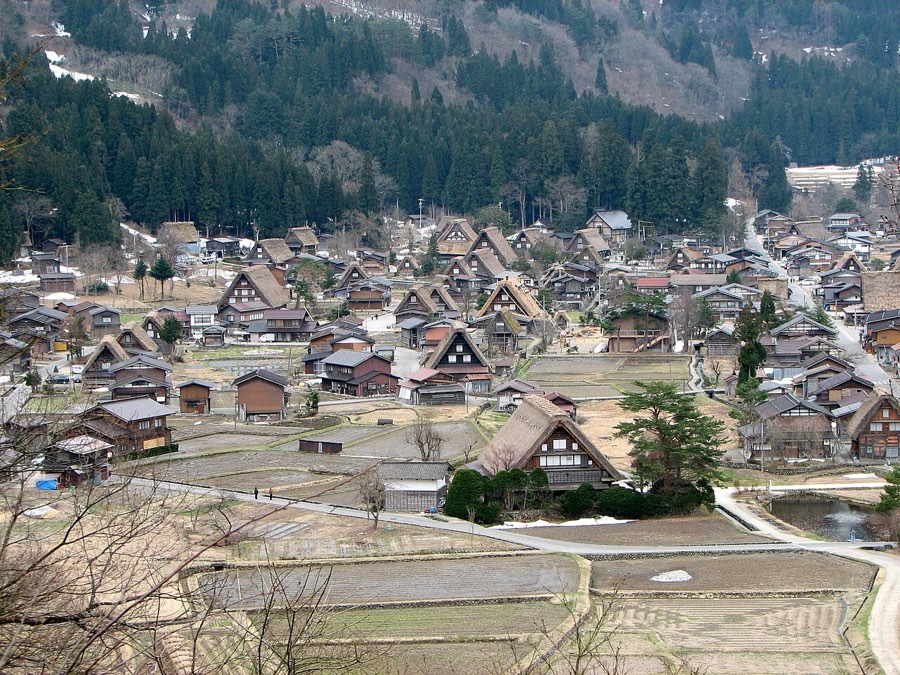
Shiroyama Viewpoint: the whole village from above
This is the spot from which the village is photographed in every picture. The shuttle leaves from near the Wada House, ¥300 each way, cash to the driver, every 20 minutes from 09:00, and the last one up is at 15:40. You can also walk up the trail, 20 to 30 minutes. The car park up there has been closed to cars since December 2023. At 09:00 the light is good, and there is no line for photos. In winter the viewpoint is closed, except on the four illumination evenings in 2027 (11, 17, 24 and 31 January), when you go up only with a viewpoint ticket.
Down to the Wada House
On the way you can stop at:
- Bunsuke: A river fish restaurant in a gassho house, on the way between the viewpoint and the village, that raises its own iwana, amago and trout in spring water.
Stop 2Traditional houseMust
Wada House: the largest house in the village, from inside
According to the village, this is the largest house left in it, about 300 years old, and the Wada family, the village headmen in the Edo period, still live in it. ¥400. On the open floors you see the family's household and work tools, and silkworms were raised in the attics of the gassho houses. Here you understand why the roof is steep: in February 170 centimeters of snow or more piles up in the village. Several more houses are open to visitors (Kanda, Nagase, the Myozen-ji museum), and one is enough.
Out into the lanes
Stop 3WalkMust
Ogimachi: the village lanes, the rice fields and Myozen-ji Temple
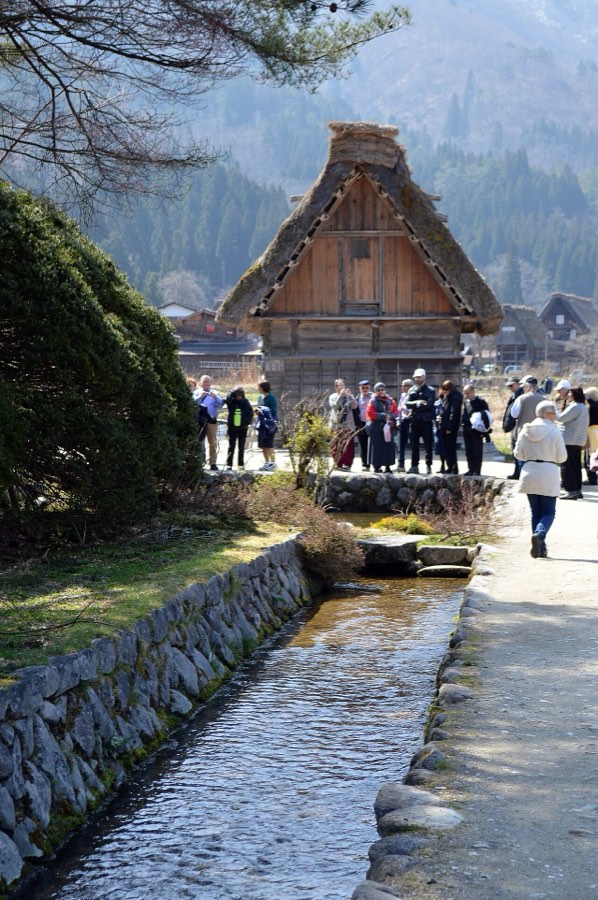
Walk the lanes between the houses, the rice fields, and Myozen-ji temple, which also has a thatched roof, with a bell in its gate. Free. People live in the houses, so do not enter the yards. There are no trash bins in the village, and flying a drone is not allowed. In the middle of the day the main street fills up, and that is the time to move to the paths between the fields.
Up to lunch
Stop 4LunchRecommended
Lunch break near the suspension bridge
Some of the houses in the village are restaurants: soba, Hida beef with miso on a magnolia leaf (hoba miso), and river fish over the fire. You eat in the south of the village, on the street that runs down to the suspension bridge, before you cross it. There is a line at midday, so you can come early, at 11:30. The options:
Across the suspension bridge
Stop 5Open-air museumIf there is time
Gassho-zukuri Minkaen: 25 houses across the river
Across the suspension bridge, an open-air museum with 25 houses moved from other villages in the valley. ¥800 (since October 2025). Quieter than the main village, and good for children. From March to November it is open 08:40 to 17:00, and from December to February 09:00 to 16:00, and entry closes 20 minutes before closing time. From December to March it is closed on Thursdays. Workshops (soba, straw weaving) run only from April to October, and need booking.
Break
An onsen or a cafe before the bus
The rest of the day, near the bus terminal. Shirakawago no Yu is a day-use onsen in the village, two minutes from the terminal, with an outdoor bath facing the river and a sauna: ¥900, towel ¥200. According to the onsen's website it is closed every Thursday and on the 2nd and 4th Wednesday of the month, so check first. If you do not want an onsen, sit in a cafe in a gassho house, such as Ochiudo (zenzai and curry, cash only), about 8 minutes from the terminal.
Back to the bus terminal
BusMust
Bus to Kanazawa, or back to Takayama
Continue to Kanazawa, to sleep there, or go back to Takayama. To Kanazawa the ride is 75 to 85 minutes depending on the bus: the 15:55 arrives at the West Exit of Kanazawa Station at 17:20. To Takayama about 50 minutes: the 15:45 arrives at 16:35. ¥2,800 each way, reserved seat. If you continue to Kanazawa with a suitcase, leave it in the morning in a locker at the village terminal. Nohi warns of delays in heavy traffic, snow and road closures, so do not book a train tight against the arrival time.
Ride to dinner
Stop 6DinnerRecommended
Dinner in Kanazawa or Takayama
You finish in the city where you sleep. In Kanazawa the local dish is oden, and you eat it in Katamachi or at the station. In Takayama the dish is Takayama ramen, a thin soy broth, but most of the town closes early, and in the evening Hida beef is a safer bet. The options:
Want to build your own trip, day by day?
JourneySketch is a trip planner we built: a plan for each day, flights, hotels and a packing list, all in one place. No signup needed.
More in the same area
Full day · Kanazawa
Kanazawa: Omicho Market, the geisha district, Kenroku-en Garden and gold leaf
Full day · Matsumoto
Matsumoto: wasabi in the field, Yayoi Kusama, the frog street and the Crow Castle
Full day · Nagano
Nagano: the snow monkeys in the onsen, Zenko-ji Temple and the town of Shibu Onsen
Full day · Tateyama, Toyama
Tateyama Kurobe: crossing the Japanese Alps from Toyama to Nagano in one day
Full day · Nozawa Onsen, Nagano
Nozawa Onsen: a ski day above an onsen village, and a free soak at Oyu to finish
Full day · GALA Yuzawa, Niigata
GALA Yuzawa: a ski day from Tokyo, with no luggage and no gear
Written as a draft and verified by hand against official sources. Opening hours and prices change, so check before you go.