Chubu & Japanese Alps · Takayama
Takayama: the morning markets, the Sanmachi lanes, sake and Hida beef
A mountain town that looks the way it did 200 years ago: two morning markets on the river, the shogun's government house, sake breweries with cedar balls at the entrance, a village of traditional houses on the hill, and Hida beef in every form.
A day on foot in Takayama, a town in the Hida mountains. You start at the morning market on the river, pass through the shogun's government house and the Sanmachi lanes, eat Hida beef at lunch, and after an hour at the hotel climb to the temple district on the hill. From there you walk down west to the station and ride to Hida Folk Village late in the afternoon, because it lies on the station side, not the old-town side. The only ride is the Sarubobo bus to the village and back, ¥210 each way. At the Nohi bus terminal a combined ticket is sold, the round trip plus entry to the village, for ¥1,000 instead of ¥1,120, valid for the same day only. The last bus brings you back to the station, and dinner is near it.
This day is part of: From the Alps to the coast: Nagoya, Takayama, Shirakawa-go, Kanazawa and Tokyo in 6 days · Ten days in Japan: Tokyo, Hakone, the Alps, Kyoto and Osaka · Two weeks in Japan: Tokyo, Nikko, Hakone, the Alps, Kyoto, Hiroshima and Osaka
The day on a map
8 stops, in order
- Stops
- 8
- Walking minutes
- 37
- Miyagawa Morning Market, then Walk 7 min
- Takayama Jinya, then Walk 5 min
- Sanmachi Suji, then Walk 3 min
- Lunch break in Sanmachi, then Walk 12 min
- Takayama Festival Floats Exhibition Hall and Sakurayama Hachimangu, then Walk 10 min
- Higashiyama Walking Course, then Bus 30 min
- Hida Folk Village, then Bus 22 min
- Dinner in Takayama
The same stops with the same numbers, and the way from stop to stop. On a phone it opens in the app, and that is what you navigate with in Japan. Pin names on the map are in Hebrew.
On Shabbat: The morning markets, Sanmachi, the red Nakabashi Bridge, Hie Shrine and the Higashiyama walking course (temples on the hillside) are all free and on foot if you sleep in the center. The government house, the festival floats museum and Hida Folk Village charge admission, skip them.
Getting there: Start at the Miyagawa Morning Market, on the east bank of the Miyagawa River, between Kajibashi Bridge and Yayoi Bridge. From JR Takayama Station walk east about 10 minutes. Coming from Nagoya: the Hida limited express, about two and a half hours, ¥6,140 with a reserved seat (covered by the JR Pass), with river views for most of the way. From Kanazawa: the Nohi bus via Shirakawa-go, reserved seats only, ¥4,200. In town everything is on foot, except Hida Folk Village.
Stop 1MarketMust
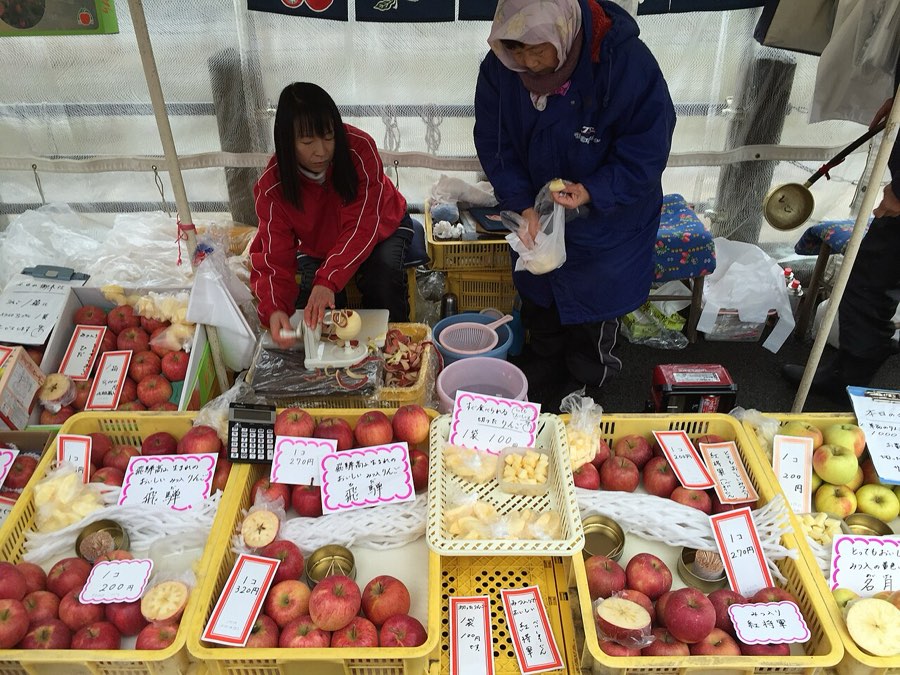
Miyagawa Morning Market: farmers, pickles and soybeans
You start at the market along the river, which according to the market union began in the mid-Edo period. Farm women sell vegetables, pickles, fruit and mochi, and sarubobo dolls, the lucky charm of Hida. From December to March the market opens at 08:00, and from April to November already at 07:00. The best of it is before 10:00. Near the bridge Kotte Ushi sells Hida beef nigiri on a rice cracker, from 10:00.
On to the government house
Stop 2Historic buildingRecommended
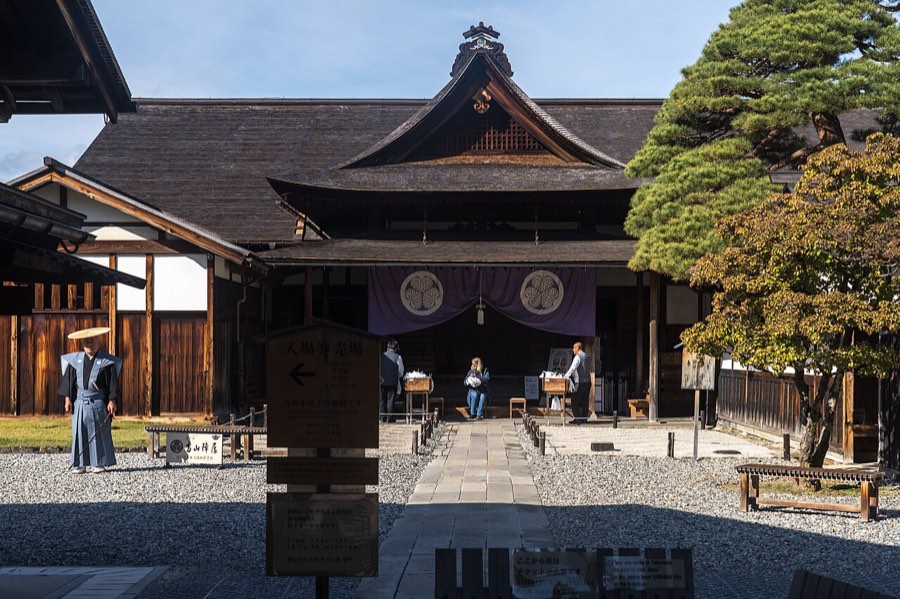
Takayama Jinya: the shogun's government house
The government house from which the shogun's officials ran the Hida province from 1692: its timber, charcoal and mines. It is the only one of about sixty such offices whose main buildings survive. You see tatami rooms, a rice storehouse, and the courtroom with the instruments of punishment. ¥500 since April 2026, and free up to high school. There is a free guide on request, so come in the morning: there are no guided tours between 11:30 and 13:30. The town's second market, Jinya-mae, is right at the entrance.
Across to Sanmachi
Stop 3Historic districtMust
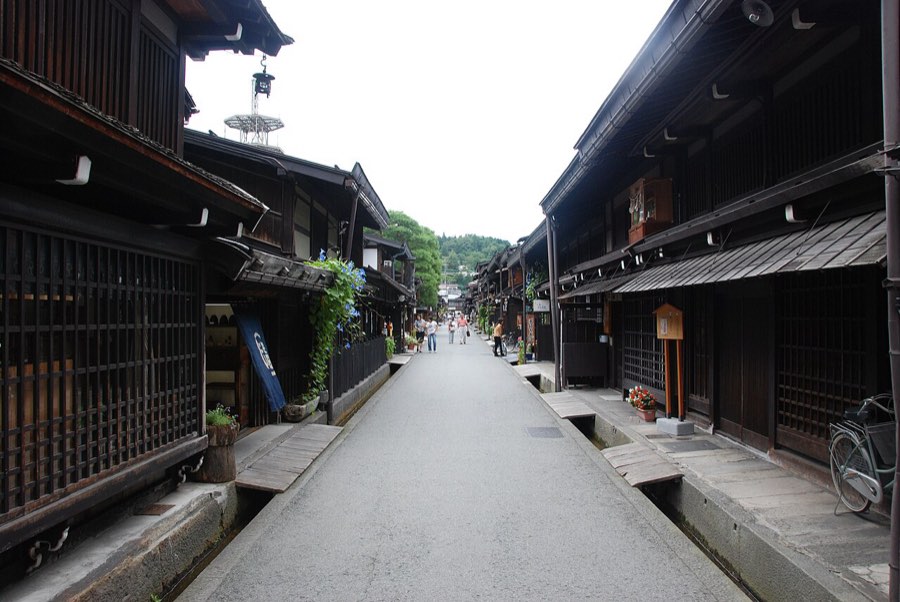
Sanmachi Suji: the lanes of merchant houses and sake breweries
Three streets of dark wooden houses from the Edo period, a national preservation district since 1979. They hold craft shops and sake breweries, which you identify by the ball of cedar branches above the door: the ball is hung green when the new sake is ready, and turns brown over the months as the sake matures. At Funasaka the tasting is free, and at Harada you buy a tasting cup. Most tastings end at about 16:00. From 10:00 the groups arrive, so start at the far end.
Down to lunch
Stop 4LunchMust
Lunch break in Sanmachi
Hida beef is wagyu from the Hida region, and here you eat it standing in the street or sitting in an old townhouse. Most places are open only until the afternoon, and almost every one has a closing day. On Wednesdays two of the options are closed:
Break
A rest at the hotel, if you are staying in the old town
This day starts at 08:00 and ends at 19:30, and almost all of it is on foot. Takayama is small, so after lunch there is an hour at the hotel. If you are staying in the old town, on either side of the river, walk a few minutes to the hotel and head out again at 14:00 for the Higashiyama trail, which starts at Unryu-ji temple. If you are staying near the JR station, it is about 11 minutes on foot from Sanmachi, and on the way back go straight to Unryu-ji, about 20 minutes from the station. That leaves you about half an hour at the hotel, which is borderline. You get a longer rest at the end of the day: the bus from Hida Folk Village reaches the station at 17:25, and dinner is at 18:00. If you do not go back to the hotel, continue to the floats hall, the next stop.
Up to the floats hall
On the way you can stop at:
- Kusakabe House: A merchant house rebuilt in 1879 after the great fire, a national cultural property. ¥1,000, 10:00 to 16:00, closed on Tuesdays.
Stop 5MuseumIf there is time
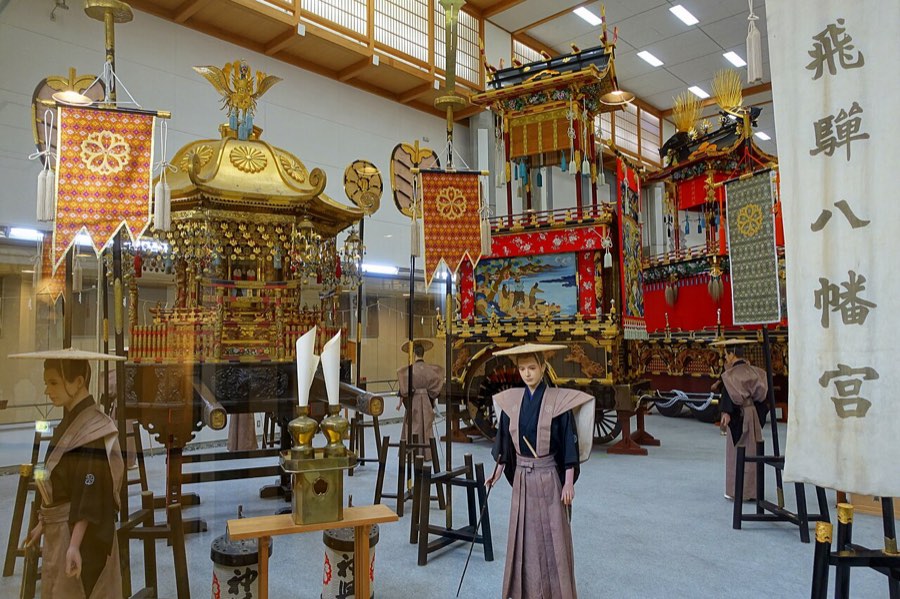
Takayama Festival Floats Exhibition Hall and Sakurayama Hachimangu
The Takayama festival is two festivals: in spring, on 14 and 15 April, and in autumn, on 9 and 10 October. Gilded floats 7 to 8 meters tall go out in them, with mechanical puppets. Outside the festival, 4 of the autumn floats are shown in a hall next to Sakurayama Hachimangu shrine, and they change three times a year. ¥1,000, including the Sakurayama Nikko-kan, a model of the Toshogu shrine in Nikko. The shrine itself is free.
Up to the Higashiyama trail
Stop 6WalkRecommended
Higashiyama Walking Course: the temple district on the hill
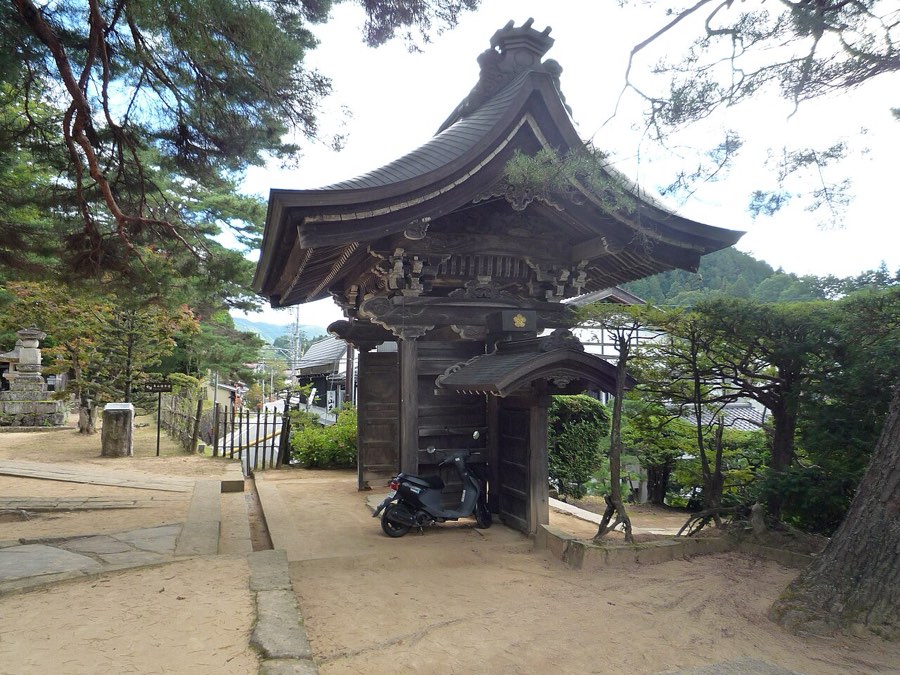
The temple district on the hills east of town, which according to the tourism site was laid out after Kyoto. You walk the northern part: from Unryu-ji temple, through temples and cemeteries in the forest, to Sogen-ji, and from there down to the station. The full trail, about 4 km to Shiroyama Park, suits another day. There are bears in the area, so do not go into the forest in the evening.
Ride to Hida Folk Village
Stop 7Traditional villageRecommended
Hida Folk Village: old thatched houses around a pond
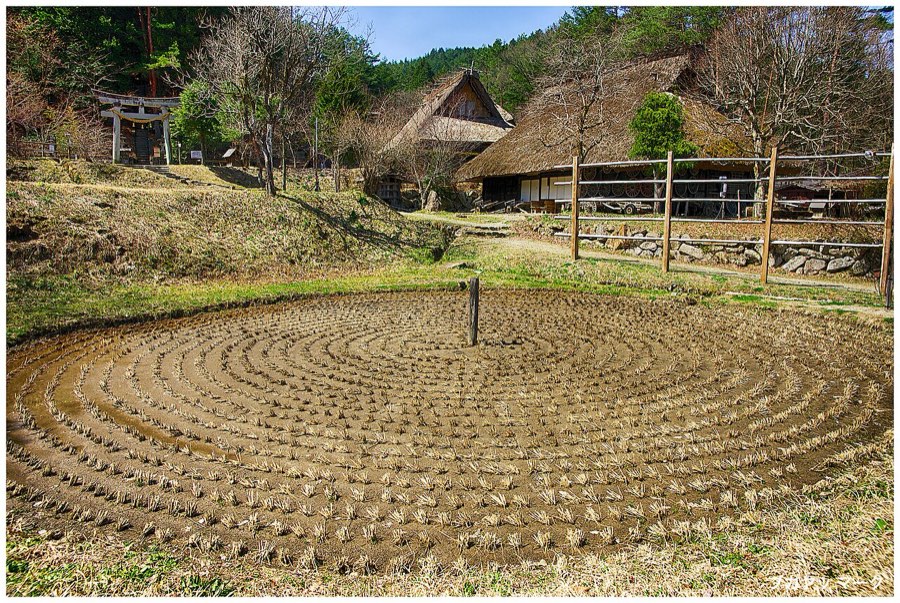
An open-air museum with more than 30 old buildings, including thatched houses, moved from villages around Hida that disappeared because of dams and depopulation, around a pond. Every morning they light the hearth in the houses, because the smoke protects the thatch. ¥700. The village closes at 17:00, and the last bus back leaves at 17:09. Opposite the village, at the crafts center, you can sew a sarubobo doll (¥2,900, last entry 15:30, so only if you come to the village earlier).
Back to the station for dinner
Stop 8DinnerMust
Dinner in Takayama
You finish near the station, where the bus stops. If you are sleeping at a ryokan, eat there: the kaiseki dinner is included, and you do not miss it. Everyone else eats Hida beef in the evening, near the station or in the old town. If you still want to see the red Nakabashi Bridge at night, it is about 10 minutes on foot from the station: it is lit only in the illumination seasons, in autumn 2026 from 1 October to 30 November, 17:30 to 21:00. Tomorrow: Shirakawa-go, about 50 minutes by bus. On Tuesdays, of the three restaurants, only Maruaki is open:
Want to build your own trip, day by day?
JourneySketch is a trip planner we built: a plan for each day, flights, hotels and a packing list, all in one place. No signup needed.
More in the same area
Full day · Shirakawa-go
Shirakawa-go: the thatched village in the valley, from the morning viewpoint to the Wada House
Full day · Kanazawa
Kanazawa: Omicho Market, the geisha district, Kenroku-en Garden and gold leaf
Full day · Matsumoto
Matsumoto: wasabi in the field, Yayoi Kusama, the frog street and the Crow Castle
Full day · Nagano
Nagano: the snow monkeys in the onsen, Zenko-ji Temple and the town of Shibu Onsen
Full day · Tateyama, Toyama
Tateyama Kurobe: crossing the Japanese Alps from Toyama to Nagano in one day
Full day · Nozawa Onsen, Nagano
Nozawa Onsen: a ski day above an onsen village, and a free soak at Oyu to finish
Written as a draft and verified by hand against official sources. Opening hours and prices change, so check before you go.